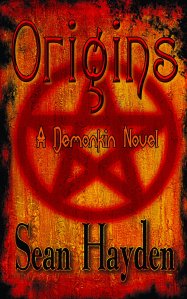
 Ya, I know what you’re thinking. “That sounds dirty.” Well it’s not. I’d heard the expression over the years, knew what it meant, but I can honestly tell you, “You’ve got it wrong!” The ultimate release is nothing of the sort. The ultimate release is knowing, within a few days or weeks, the book you wrote will finally, finally be available for people to read.
The release of Origins has been one HELLUVA ride. I don’t see it as being over, either. These long and winding months of waiting are drawing to a close, but that wasn’t the ride. That was the rollercoaster climbing the first incline after leaving the gate at the amusement park. The real ride is just beginning. When it’s available for purchase, the rollercoaster will just be cresting that first hill and the whole ride will be laid out and I’m expecting to yak over the side of the car at some point in time (the true sign of a great ride).
Many of you might not know, but I only started writing about a year and a half to two years ago. I’ve said it before and I’ll say it again. The reason I started writing is very simple. I had read a lot of things out there that I couldn’t believe had been published. I bought them for their shiny covers (ya, I know I shouldn’t judge it from it, but I did. Sue me), brought them home, brewed some coffee, got through the first few chapters, and threw them down in disgust. “How the hell did that get published?” Ever have one of those moments? Ever have one of these? “I could write better than that!”
I said it, and I realized what I said as the words dribbled from my numb lips. Did I just say I was going to write a book? Could I? Would I? Should I? I did.
As the final words of Origins made their way from my imagination, through my fingertips, onto the keys of my laptop computer, and etched onto the screen and hard-drive of my computer, I SMILED. I had done it. Now I just needed to find somebody to publish it. That would be easy, right?
*Insert hysterical, maniacal laughter soundtrack here*
Okay. Let me tell you something. WRITING A BOOK IS EASY!
There, I said it.
Now let me tell you what’s not. FINDING A PUBLISHER!
The rollercoaster lap-bars had come down, the ride was starting to move slowly forward. GASP! There’s a hiccup in the rides internal circuitry. Now the car will sit for a few months while they repair the ride.
Uh, huh. That’s what happened to our brave adventurer. He had a completed manuscript, but because he knew nothing about being an author or finding an agent or finding a publisher, he relied on the greatest purveyor of ultimate truth. The internet. I mean, if it’s on Google, IT HAS TO BE TRUE? RIGHT?
Ya, not so much.
“You will never get you published if you ain’t got an agent, son,” said the carnival operator to our stranded hero.
“Gosh, I’m gonna have to get me one of those,” I said.
And so I wasted the next five months of my life looking for an agent. See, the problem was agents are busy. What I didn’t know at the time was that I wasn’t the only hombre who had hopped on the “I WROTE A BOOK” rollercoaster. I had a lot in common with those other folks too. Not only had they written about vampires, too, but they were also (forgive my use of foul language) unpublished authors! Duh, duh, duuuuuuuuuuuuuuh. See, we are the LEPERS of the publishing industry. Because we had never had our work published in so much as a school newspaper (I’m kidding, don’t put that down on your resume), agents wouldn’t even take the time to read our stories. The bastards (yeah, I said it).
“Well, no problem,” I said when I realized that my rollercoaster wouldn’t get going if I kept vainly searching for someone from the Dewey, Screwum, and Howe Literary agency to take a gander at his magnificent manuscript. “I’ll just go right to the source and find me a PUBLISHER!” HEAD –>DESK
Have you ever heard the term SLUSHPILE? Sounds nummy, don’t it? Like a big SLURPEE just sittin there waitin for you and a straw. Hope it’s cherry. Hope somebody actually runs out of suggested manuscripts from reputable agents, skims through said pile, singles out your manuscript, gives it a read, likes it, makes you an offer, and publishes you. That would be nice, wouldn’t it? So would going to a local convenience store, picking up one of those little pencils, grabbing a lottery form, making little black squares with #2 lead, waiting until drawing night, watching the blond in the shiny dress pull little numbered balls out of an acrylic tube hooked up to a backwards ass vacuum, and watching your numbers come up.
Then, one cloudless summer’s day, a ray of light shone down from the heavens, lit up my keyboard, and a choir of angels sang out in joyous three-point harmony as I hit “ENTER” on my latest Google search. I had heard the term “INDI PUBLISHER” and decided to give it a whirl. Hmmmm, Echelon Press, that sound’s cool. Let me give them a shot. “BEST DAY EVER.”
Slowly, the ride crept forward on its rickety wooden frame and iron tracks. I could feel my manuscript and the ride of my new career being propelled slowly forward.
That was several months ago. The ride was filled with exciting things like getting my cover, and being assigned an editor, and then seeing the different edits as the book changed into something a little less raw and something more akin to the dreams I had of holding my book. Looking back, I can honestly say, there isn’t one thing I would change about the whole ride. It taught me so much, not only about publishing and writing, but about patience and perseverance as well. It made me not only a better author, but a better person as well. I just can’t believe I kept my sense of humor through the whole thing. What’s that? My sanity? HEHEHE. That’s a different story.
Origins
Ashlyn Thorn was born different. She was born with all the characteristics of a vampire, but in a world where vampires, elves, and werewolves work, play, and die side by side with normal humans, everyone knows vampires aren’t born, they’re made. The only thing she ever wanted is to know her true Origins. Ashlyn’s tale takes her on a quest to find out what makes her different and to find out the truth, but with every question she gets answered, she uncovers more uncertainties. To make things worse she makes enemies of the most powerful vampires of the city who consider her powers to dangerous to let go unchecked. She is saved by the government only to be trained and used to serve their purposes, and Ashlyn finds herself torn between two worlds. She can either be a monster, or help fight the monsters.
 Born in the suburbs of Chicago, Sean Haydeen moved to the frigid arctic climes of southeast Florida as a small child. The son of a fireman and a proofreader (that’s what they had before spellcheck) he fell in love with reading at a young age. When he hit the age of 35 he wrote his first novel, an urban fantasy about vampires and demons entitled Origins. Unsatisfied with one novel, he penned the sequel Deceptions and both titles of the Demonkin Series will be available from Echelon Press soon.
Facebook
Blog
Twitter
Web:

 “Okay, let me say this once and get it off my chest and never mention it again. I have had it with writers who talk about how painful and harrowing and exhausting and almost impossible it is for them to put words on paper …”
 Writers aren’t that special. Everybody’s work hits snags from time to time. If you want to write (as oppose to wanting to have written), then you’ll find a way around these snags, and actually enjoy doing it. The principal way is to have a queue of many writing tasks, so if you’re stuck on one for the moment, you can switch to another. That’s part of my Fieldstone Method. (Weinberg on Writing: The Fieldstone Method.)







 Journey of the Heart